

In recent years, California has seen rising instability in its home insurance market. This turbulence has exacerbated the state’s well-documented housing affordability challenges. Historically, California’s insurance costs have been low compared to its home values. As climate-related risks have escalated, home insurance rates have risen. But recent increases may not be enough to mitigate insurer risk: Since 2022, 7 of the state’s top 12 providers have reduced their coverage, and some have exited the market.
California’s insurance market has been closely regulated since the passage of Proposition 103 in 1988. Before Prop 103, insurers were not required to submit rates to the California Department of Insurance, which was headed by a governor-appointed commissioner. Prop 103 established a rate approval process and empowered an elected insurance commissioner to approve or reject rate changes. Prop 103 also required insurers to base their rates on past losses rather than on projections known as catastrophe models.
As a result, California’s insurance costs are lower than those in other states. The cost of homeowner’s insurance depends on the price of the house, so the best way to compare costs across times and places is by comparing insurance burdens: insurance costs as a share of all homeownership expenses. In 2023, California’s statewide insurance burden (4.6%) was one of the lowest in the country; Louisiana and Oklahoma led the nation with burdens of 12.8% and 12.3%. And while California’s median burden has increased 1.3 percentage points since it hit a low in 2008, the increase in the rest of the country was 2.4 percentage points. Sources with more recent data show a sharper increase in the last year, but a similar overall pattern.

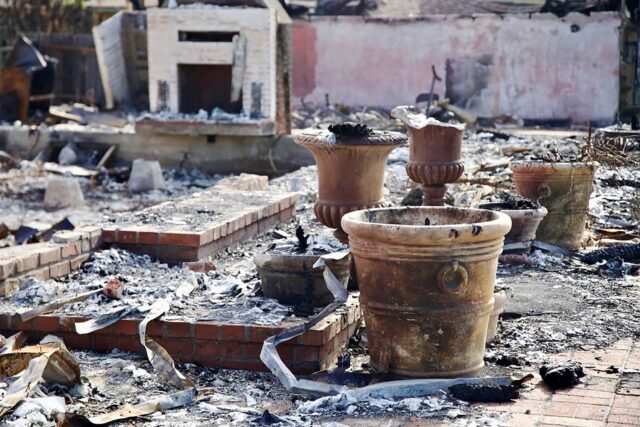
Insurance burdens have been relatively low and stable outside the parts of the state that have been hardest hit by recent wildfires. Since 2012, burdens in the far north—which has endured a series of devastating fires—have risen 2.2 percentage points, compared to a median increase of 0.8 percentage points in the rest of the state. Not surprisingly, the far north had the highest median burden in 2023 (7.7%), while burdens were 4% to 5% along the coast from the San Francisco Bay Area to San Diego. Given the catastrophic Southern California fires earlier this year, this gap may soon close.

Low costs and small increases might seem like good news. However, the financial risks posed by wildfires may be outstripping the insurance rates that homeowners are paying. Insurers do have reinsurance to cover higher-than-expected payouts, but this “insurer’s insurance” has not prevented outright losses for many companies. As a result, many insurers have been canceling or declining to renew policies. Between 2019 and 2024, more than 100,000 homeowners lost coverage.
In California and more than half of US states, Fair Access to Insurance Requirements (FAIR) plans serve those with risks too high for the traditional insurance market at the rates currently charged. The California FAIR Plan, as an “insurer of last resort,” is generally more expensive and provides lower levels of coverage than regular-market plans. Nonetheless, FAIR enrollment has grown 115% since 2021, notably around the fire-prone Sierra Nevada Mountains and along the coast. As more homeowners turn to FAIR, rates could increase across the board, because the state’s licensed property insurers are the plan’s financial backstop.
Recently, California insurance commissioner Ricardo Lara announced a suite of reforms such as allowing insurers to factor in reinsurance costs when setting rates and allowing catastrophe modeling for more policies. But these reforms also require insurers to increase their coverage in high-risk neighborhoods by 5% every two years until their policies cover 85% of the statewide insurance market, relieving pressure on the FAIR Plan.
Amid rising climate-related threats to California’s housing stock, the state will need to continue its efforts to address both the difficulties faced by private insurers and the needs of homeowners. Stay tuned for more analysis of the state’s ongoing homeownership and climate challenges.