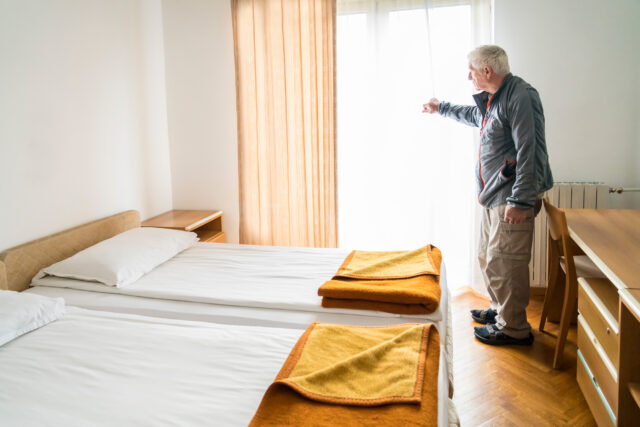
Californians have consistently cited homelessness as a top issue facing the state, and in 2024, homelessness reached record highs. Of the nation’s 771,500 people experiencing homelessness, over 187,000 (24%) were in California. Two in three were unsheltered, accounting for almost half of the country’s unsheltered population.
However, homelessness grew at a higher rate in the nation (18%) than in California (3%) from 2023 to 2024, driven by a 25% jump in sheltered homeless in the US compared to 9% in California. Unsheltered population growth in the US (7%) also outpaced California (0.4%), reversing the previous decade’s trend of larger increases in California.
Each January, the US Department of Housing and Urban Development (HUD) requires federally funded local agencies to conduct a “point-in-time” (PIT) count of people experiencing homelessness on a given night. Despite limitations, including concerns with undercounting, these annual PIT counts provide one of the few lenses on homelessness at the federal, state, and local levels.
Continuums of Care (CoCs)—local coalitions of government and non-profit entities—provide services to people experiencing homelessness and report annual PIT counts that align with California’s counties or county groups. Analyzing changes across CoCs reveals trends in homelessness throughout the state.
Over 70% of people experiencing homelessness in California were in the 10 CoCs with the largest homeless populations in 2024. Sheltered homelessness rose by 10% while unsheltered homelessness fell by 3% (excluding Santa Clara and Fresno/Madera, which did not conduct unsheltered counts). Total homelessness in these 10 CoCs grew by 1.3%.
- For Los Angeles, Alameda, and San Francisco CoCs, unsheltered homeless populations fell, but sheltered populations rose (14%, 18%, and 25%, respectively).
- San Diego reported a rise in unsheltered (18%) and a drop in sheltered homelessness (-12%).
- Sacramento reported the largest decrease and San Joaquin reported the largest increase in homelessness, but these trends may be due in part to changes in local counting methods.
Across all other California CoCs, total homelessness grew by 8%. Many of these CoCs cover counties with smaller cities or largely suburban and rural areas.
- Monterey/San Benito, Kern, and Contra Costa CoCs reported increases of 38%, 37%, and 20% in total homelessness.
- Unsheltered homelessness increased by over 50% in Lake, Yolo, Kern, and Solano CoCs.
- Riverside, Tehama, Napa, and San Mateo CoCs reported increases in sheltered homelessness of over 25%.
- Alpine/Inyo/Mono and El Dorado CoCs also reported stark rises in sheltered homelessness, but given smaller overall populations, these changes represent a much smaller number of people experiencing sheltered homelessness.
However, some of these less populated counties have much lower overall numbers of people experiencing homelessness than larger CoCs.
Mitigating homelessness will require a mix of short-term supports such as financial assistance and behavioral health support, as well as long-term strategies, including building more housing. Rising home prices and rent have outpaced home building in the state, and California has among the lowest homeownership rates in the country. Over a quarter of Californians, including four in ten lower-income adults, worry about their housing costs every day or almost every day. Furthermore, tailored approaches are needed to address changing conditions at the local level, as homelessness and housing vary across urban, suburban, and rural areas.
California lawmakers have invested tens of billions of dollars to support homelessness programs in recent years. Last year, a statewide audit found that the state lacked sufficient information to assess the effectiveness of these investments. The governor’s January budget plan proposes establishing the California Housing and Homelessness Agency to better integrate the state’s homelessness response. It also proposes to enhance accountability efforts for existing homelessness program funds.
Additionally, funds to implement Prop 1 (passed by voters last March) are expected to increase, which would expand treatment and supportive housing services for people with behavioral health needs who are experiencing homelessness or are at risk. As the legislature develops its final budget for June, the state has unveiled a three-year action plan that sets targeted goals for preventing and ending homelessness across California.
PPIC will continue to track homelessness data and monitor recent developments in this rapidly shifting policy landscape.
Topics
California State Legislature Health & Safety Net homelessness homeowners Housing housing costs Political Landscape Population Poverty & Inequality renters state budgetLearn More
Californians’ Concern about Homelessness Has Softened

Evictions in California Have Leveled Off, with Upticks in Some Counties

Exploring Record-High Student Homelessness