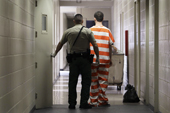


Since the mid-1990s, California has gone from introducing one of the nation’s toughest crime laws to leading efforts to reduce incarceration. Today, the pendulum may be swinging back as Californians express concerns about rising crime. For the upcoming November ballot, there is widespread support for Proposition 36, which would increase penalties for some drug and property offenders. On PPIC’s 30th anniversary, we provide an overview of how incarceration, violent crime, and property crime have changed in California—and how they compare to national trends.
The state’s incarceration rate (the number of jail and prison inmates per 100,000 residents) currently stands at less than two-thirds of what it was 30 years ago. While violent and property crime rates are less than half of what they were, and property crime is at pre-pandemic levels, violent crime rose during the pandemic and is still about 15% higher than it was before the pandemic.
The criminal justice landscape looked remarkably different 30 years ago. In 1994, amid historically high levels of violent crime, voters in California passed the “three strikes” law, which imposed a minimum 25-year sentence for any third felony conviction for those with two prior convictions for serious or violent crimes, as defined by the state’s penal code. California’s prison population, which had already been surging, jumped by 30% in five years—and had grown by almost 50,000 inmates (or 39%) when it peaked in 2007.
Although the state added several prisons, the prison population significantly outpaced capacity, leading to dramatic overcrowding and poor conditions. After several lawsuits, a federal three-judge panel was appointed in 2007 and ordered the state to reduce overcrowding to 137.5% of systemwide design capacity in 2009, a ruling that was later upheld by the US Supreme Court.
Over the next decade, California was at the forefront of reforms to reduce incarceration. In 2009, Senate Bill (SB) 678 provided financial incentives to counties to lower the number of felony offenders sent to state prison for probation failures and SB 18 allowed some parolees to be put on non-revocable parole upon release from prison.

While these bills helped lower the prison population, public safety realignment in 2011—which shifted responsibility over lower-level felons from state prison and parole to county jail and probation systems—had a much larger impact. After realignment, the state prison population plummeted by about 27,000, offset partly by an increase in the county jail population of roughly 9,000. Then in 2012, voters passed Prop 36, which revised “three strikes” by limiting life sentences to when the new, third-strike felony conviction is serious or violent.
However, it was not until voters passed Prop 47 in 2014 that the prison population decreased below the federally mandated level. The initiative passed by a wide margin, reclassifying some drug and property offenses (with theft value $950 or less) from felonies to misdemeanors, creating a specific misdemeanor shoplifting category, and generating $800 million so far in savings that provides funding for treatment and diversion programs. Reforms continued in 2016, when voters passed Prop 57, which provided earlier eligibility for parole for non-violent prison inmates and increased incentives for good behavior and participating in and completing prison programs, resulting in shorter time served.
In 2020, the COVID pandemic caused another huge disruption to California’s jails and prisons, with effects that persist today. The criminal justice system’s efforts to prevent the spread of COVID led to notable decreases in the number of jail and prison inmates. Between the end of 2019 and late 2023, the jail population dropped by almost 15,000 inmates and the prison population by almost 30,000, allowing the state to close two prisons (with plans to close one more).
The state’s incarceration rate is now 36% lower than it was three decades ago, down from 613 to 393 per 100,000 residents. The dramatic decrease in California’s incarcerated population has led to significant savings to the state and county governments, although the latter is difficult to assess. Spending on the state correctional system dropped notably, from 9.4% of the state’s General Fund in 2007 (when the federal three-judge panel was appointed) to 6.7% in 2024.
Reducing incarceration has raised concerns that crime would increase as a result. However, property crime decreased in 13 of the 17 years between 2007 and 2023; it is now 44% lower than in 2007 and 55% lower than it was 30 years ago. California’s violent crime rate decreased in 9 of the 17 years; it is now 4% lower than it was in 2007 and slightly less than half of what it was 30 years ago.
Overall, realignment, Prop 47, and the pandemic have led to the largest drops in the state’s incarcerated population, and a growing body of research reveals that these decreases led to upticks in property crime but have not affected violent crime. The reduction in the prison incarceration rate due to realignment contributed to an increase in auto theft. Meanwhile, decreases in incarceration due to Prop 47 led to more auto thefts and car break-ins, and commercial burglaries rose during the pandemic due to the drop in the jail population.
Comparing incarceration and crime in California with the rest of the nation provides a broader context for state trends. California’s incarceration rate was similar to that of the rest of the nation in 2007, but it was lower—roughly three-quarters of the national benchmark—in 2022, the latest data available.
Meanwhile, the state’s violent crime rate stayed consistently 5–10% higher than the rest of the country during the reform era. But after the pandemic, violent crime increased more in California. (We exclude data from the Los Angeles Police Department as violent crime was significantly underreported by the agency during this period.)
Thirty years ago, the property crime rate in California was lower compared to the rest of the nation—but it is higher now. After realignment and Prop 47, the property crime rate went from being roughly 8–10% below that of the rest of the country to 6% higher in 2015. After the pandemic, the difference between the state’s property crime rate and the national benchmark rose to 23%.

Given the substantial drop in the state’s incarceration rate, impacts on crime remain limited to property crime, and the impacts from Prop 47 and the pandemic are not greater than those of realignment. In addition, while the impacts of Prop 47 and the pandemic on property crime are statistically significant, they represent a small fraction of the total rise in crime during those periods. Existing research suggests that when incarceration rates are already low, further decreases might lead to greater impacts on crime—but California does not appear to have reached that point yet.
Moving forward, the state should closely monitor the effects of further decreases in incarceration that may eventually result in greater impacts on crime—and should also consider using savings from less incarceration for evidence-based alternatives to jail and prison for some offenders. Possible areas of investment include addressing the continued decline in law enforcement staffing and establishing preventive interventions among targeted groups, including at-risk youth and people with behavioral and substance use challenges.
Topics
coronavirus crime Criminal Justice incarceration jails PPIC 30th anniversary prisons Proposition 47 public safety realignment three strikesLearn More

California’s Prison Population
Crime Trends in California
California’s County Jails

Overall Crime in California Fell Last Year, but Shoplifting Continued to Rise

Early Implementation of Prop 36 Varies Widely across Counties

Crime after Proposition 47 and the Pandemic

California’s Violent Crime Rate Is Diverging from the National Trend